
Important Questions
Multiple Choice Questions:
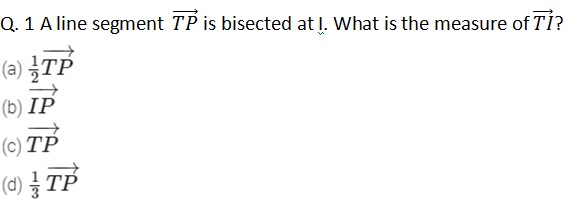
Q.2 Which of the following can be drawn on a piece of paper?
(a) A line
(b) A line segment
(c) A ray
(d) A plane
Q.3 At 7 a.m. the angle between the Sun’s ray and the ground at a point is 43°.
What would be the angle at 10 a.m.?
(a) 40°
(b) 90°
(c) Between 43° and 90°
(d) Greater than 90°
Q.4 Identify the uses of a ruler.
(a) To draw a line segment of a given length
(b) To draw a copy of a given segment.
(c) To draw a diameter of a circle.
(d) All the above.

(a) 37.5°
(b) 74°
(c) 64°
(d) 75°
Q.6 X and Y are two distinct points in a plane. How many lines can be drawn
passing through both X and Y?
(a) 0
(b) 1
(c) Only 2
(d) Infinitely many
Q.7 Lines a, b, p, q, m, n and x have a point P common to all of them. What is the name of P?
(a) Point of concurrence
(b) Point of intersection
(c) Common point
(d) Distinct point
Q.8 If two lines have only one point in common, what are they called?
(a) Parallel lines
(b) Intersecting lines
(c) Perpendicular lines
(d) Transversal
Q.9 Two lines are said to be perpendicular to each other when they meet at ____angle.
(a) 180°
(b) 90°
(c) 60°
(d) 360°
Q.10 How do you draw a 90° angle?
(a) By drawing a perpendicular to a line from a point lying on it.
(b) By bisecting a 120° angle.
(c) By bisecting a 60° angle.
(d) By drawing multiples of 45° angle.
Q.11 Angles of set squares are 45, 90 and ____.
(a) 60
(b) 75
(c) 30
(d) 90
Q.12 A ________ is the longest chord of a circle.
(a) diameter
(b) radius
(c) None of these
(d) chord
Q.13 If the radius of a circle is 8.5 cm, then the diameter of the circle is ____.
(a) 17 cm
(b) 12 cm
(c) 8.5 cm
(d) None of these
Q.14 If the radius of a circle is 3 cm, then the diameter of the circle is ____.
(a) 1.5 cm
(b) 6 cm
(c) 3 cm
(d) None of these
Q.15 If the radius of a circle is 5.5 cm, then the diameter of the circle is ____.
(a) 11 cm
(b) 5.5 cm
(c) 12 cm
(d) None of these
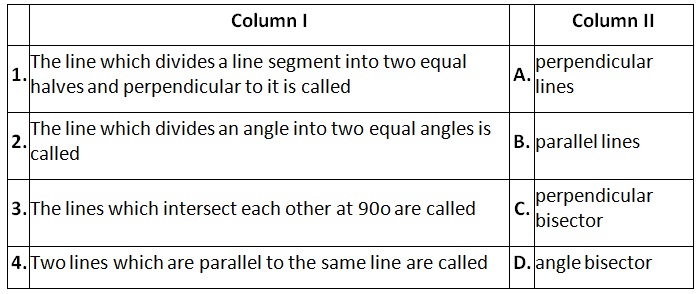
Match The Following:
Fill in the blanks:
1. The image of points A and B in the line l are P and Q respectively then (PQ) ̅ = ________.
2. To bisect a line segment of length 5cm, the opening of the compass should be more than half of ________.
3. If an angle of measure 90° is bisected twice the angle so obtained measures _________.
4. In an isosceles ∆PQR, the bisector of ∠Q and ∠R meet at O. If ∠QOR = 140°, then ∠P = ______.
True /False:
1. Two line segments are compared in terms of their lengths.
2. When a ray makes one complete rotation, the measure of angle formed is 90°.
3. With the help of compasses we can draw 80°.

Very Short Questions:
1. If an angle of 110° is bisected, find the measure of each angle formed.
2. Draw two line segments which are perpendicular to each other using set squares.
3. Construct an angle of 60° using compass and ruler.

5. Draw any circle and mark points A, B and C such that:
(i) A is on the circle.
(ii) B is the interior of the circle.
(iii) C is the exterior of the circle
Short Questions:

2. Construct a perpendicular to a given line segment at point on it.
3. Construct an angle of 60° and bisect it.
4. Draw an angle of 120° and hence construct an angle of 105°.
5. Using compasses and ruler, draw an angle of75° and hence construct an angle of

Long Questions:


3. Draw ∆ABC. Draw perpendiculars from A, B and C respectively on the sides BC,
CA and AB. Are there perpendicular concurrent? (passing through the same points).
Assertion and Reason Questions:
(1) Assertion (A): In a triangle D ABC, if ∠B=90°,then it is a right angled triangle.
Reason(R): If any one of the angles of a triangle is right angle, then it is a right angled triangle.
(a) Both A and R are individually true and R is the correct explanation of A:
(b) Both A and R are individually true but R is not the correct explanation of A.
(c) A is true but R is false.
(d) A is false but R is true.
(2) Assertion (A): In an equilateral triangle, if one angle equals 60°, then rest of the two are 150° each.
Reason (R): In an equilateral triangle, all three angles are equal.
(a) Both A and R are individually true and R is the correct explanation of A:
(b) Both A and R are individually true but R is not the correct explanation of A.
(c) A is true but R is false
(d) A is false but R is true.