
Important Questions
Multiple Choice Questions:
1. A triangle has:
(A) one element
(B) two elements
(C) 6 elements
(D) none of these
2. A point where three or more lines meet is called:
(A) point of concurrence
(B) meeting point
(C) collinear point
(D) non-collinear point
3. What are used to represent points?
(A) Numerals.
(B) Capital letters of alphabet.
(C) Lower case letters of alphabet.
(D) All of the above
4. Which instrument is used to compare two line segments?
(A) Compasses
(B) A divider
(C) Set squares
(D) A protractor
5. A __________ of a circle is a line segment joining any two points on the circle.
(A) chord
(B) diameter
(C) radius
D. None of these
6. A quadrilateral has:
(A) one vertex
(B) two vertices
(C) three vertices
(D) four vertices
7. The meeting point of a pair of adjacent sides of a polygon is called its:
(A) vertex
(B) diagonal
(C) adjacent angles
(D) none of these
8. An angle is made up of two ________ starting from common end point.
(A) rays
(B) vertices
(C) lines
(D) points
9. If two lines intersects each other then the common point between them is known as point of _________.
(A) concurrence
(B) intersection
(C) vertex
(D) contact
10. What is a set of points extending infinitely in all directions on the same flat surface called?
(A) A line
(B) A plane
(C) Ray
(D) A point
11. A quadrilateral has:
(A) one diagonal
(B) two diagonals
(C) three diagonals
(D) four diagonals
12. Three or more points are collinear if they lie on the:
(A) same line
(B) two lines
(C) same surface
(D) none of these
13. Flat surface in which two points are joined by using straight line is classified as:
(A) line
(B) plane
(C) ray
(D) intersecting line
14. What is the number of end points of a line?
(A) Zero
(B) Two
(C) One
(D) Three
15. Angle which is less than 90° is called
(A) reflex angle
(B) obtuse angle
(C) acute angle
(D) right angle
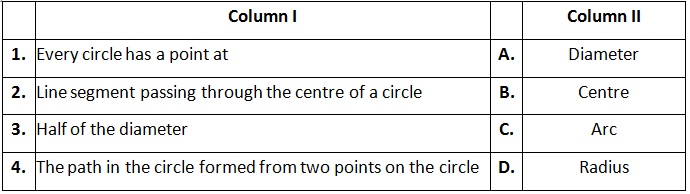
Match The Following:
Fill in the blanks:
1. ________ has no length, breadth, height or thickness.
2. A line segment has a definite ___________ .
3. Curves that do not intersect themselves are called ___________ curves.
4. An ‘angle’ is made up of ___________ rays having a common end point.
True /False:
1. A point indicates a definite position.
2. A line segment is a part of a plane.
3. A line is a set of points closely arranged.
4. Two lines in a plane always intersect in a point.
Very Short Questions:
1. Draw rough diagrams to illustrate the following:
Open curve.
Closed curve.
2. How many end points a line segment have?
3. Illustrate, if possible, each one of the following with a rough diagram:
(a) A closed curve that is not a polygon.
(b) An open curve made up entirely of line segments.
(c) A polygon with two sides.
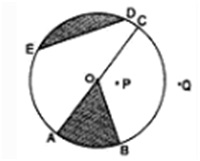
4. From the figure identify
(a) the center of circle.
(b) three radii
(c) a diameter
5. Write the points which are:
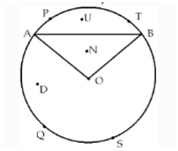
(i) in the minor sector OAPB
(ii) minor segment ATB
(iii) major sector OAQB
(iv) major arc AQB
(v) minor arc APB
6. Define the following terms:
(i) Line segment,
(ii) Line,
(iii) Intersecting lines,
(iv) Parallel lines
7. Draw a rough sketch of closed curve made up of line segments.
8. Draw two different angles having common point and a common arm.
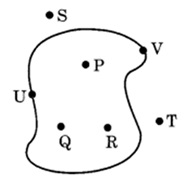
9. Identify the points which are:
(i) in the interior
(ii) in the exterior
(iii) on the closed curve in the given figure.
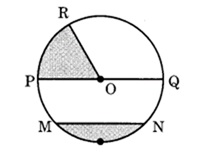
10. Identify the following in the given figure:
(a) Sector
(b) Chord
(c) Diameter
(d) Segment.
Short Questions:
1. Using the given figure, name the following:
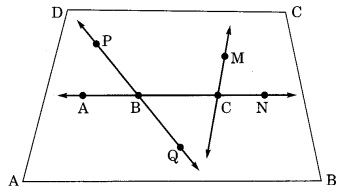
(a) Line containing point M.
(b) Line passing through four points.
(c) Line passing through three points.
(d) Two pairs of intersecting lines.
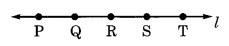
2. On the given line, some points are given, write down the names of all segments.
How many lines can pass through
(i) one given point?
(ii) two given points?
(iii) three non-collinear points+
3. How many lines can pass through,
(i) one given point?
(ii) two given points?
(iii) three non-collinear points
4. Look at the given figure and answer the following:
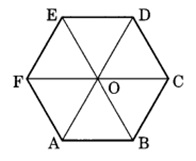
(a) Name the sides of the polygon ABCDEF.
(b) Name any two pairs of adjacent sides. .
(c) Name all the segments which intersect each other at one point.
(d) Name all the diagonals of the given polygon.
Long Questions:
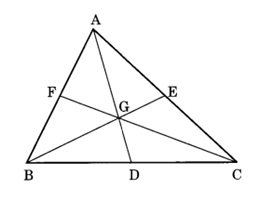
1. Draw the medians of a AABC and answer the following:
(а) Name the three medians.
(b) Do the medians intersect each other at the same point?
(c) What is that point called?
(d) Can this point be outside the triangle?
2. Draw an equilateral ∆ABC of any size. Draw AD as its median and an altitude AM.
(i) Does AD coincide with AM?
(ii) Name the point on the median which divides it in the ratio 1:2.
(iii) What is the measure of ∠ADC and ∠ADB?
(iv) Are D and M the same points?
3. In the given figure, l, m and n are three parallel lines, x and y intersect these lines.
(i) Name the points lying on the line x.
(ii) Name the points lying on the line y.
(iii) Name the points inside the quadrilateral ABED.
(iv) Name the points outside the quadrilaterals ABED and BCFE.
(v) Name the lines passing through three points.
Assertion and Reason Questions:
(1.) Assertion (A) –The term ‘Geometry’ is the English equivalent of the Greek word ‘Geometron’.
Reason (R) –‘Geo’ means Earth and ‘metron’ means Measurement.
(a) Both A and R are true and R is the correct explanation of A
(b) Both A and R are true but R is not the correct explanation of A
(c) A is true but R is false
(d) A is false but R is true
(2.) Assertion (A) –All objects have different shapes.
Reason (R) –Even today geometrical ideas are reflected in all forms of art, measurements,
architecture, engineering, cloth designing etc.
(a) Both A and R are true and R is the correct explanation of A
(b) Both A and R are true but R is not the correct explanation of A
(c) A is true but R is false
(d) A is false but R is true