
Subject and Predicate
What is a Subject and a Predicate?
• A complete sentence is a combination of two parts—a subject and apredicate.
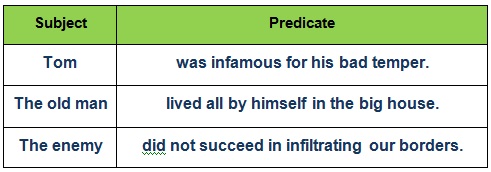
SUBJECT
• A subject is the person or thing on which the sentence isbased.
In the first sentence, ‘Tom’ is the person about whom something is being said; therefore, it is the subject.
The same logic applies to ‘The old man’ and ‘The enemy’ which are the subjects of the respective
sentences which follow.
• A subject consists of a noun; however, pronouns such as ‘I’, ‘we’ and ‘they’ can also be the
subjects of sentences.
Examples:
I do not have time to tend to this garden.
We have been working on this project for a very long time.
They did not expect the girl to be so confident.
‘I’, ‘We’ and ‘They’ are the subjects of the sentences stated above as the sentences are based on them.
PREDICATE
A predicate (or the second part of a sentence) is the part which tells us more about the subject.
It is the part which adds meaning to the subject.
In the first sentence, ‘was infamous for his bad temper’ tells us more about ‘Tom’ (or the subject);
therefore, it is the predicate.
Examples:
I do not have any plans for this weekend.
We have been working on this project for a very long time.
They did not expect the girl to be so confident.
Let us look at some more examples of subjects and predicates within sentences.
Examples:
1. The doctor treated his patients with care andconcern.
Subject: Thedoctor
Predicate: treated his patients with care and concern
2. Neither Sam nor Mike was invited to theparty.
Subject: Neither Sam norMike
Predicate: was invited to the party
3. We cannot cast a vote in the name of the absentparty.
Subject:We
Predicate: cannot cast a vote in the name of the absent party
4. Ramesh will be giving the vote of thanks to the chiefguest.
Subject: Ramesh
Predicate: will be giving the vote of thanks to the chief guest
5. Whom were you speaking to on your cellphone?
Subject:Whom
Predicate: were you speaking to on your cell phone?