
Countable and Uncountable Nouns
What are Countable and Uncountable Nouns
• Most nouns can be assessed in quantity.
• We categorise them as countable and uncountablenouns.
What is a countable noun?
• A countable noun refers to a thing which can be counted using numbers.
• Indefinite articles ‘A’ and ‘An’ can be used only withcountable nouns.
• The definite article ‘The’ can also be used with countablenouns.
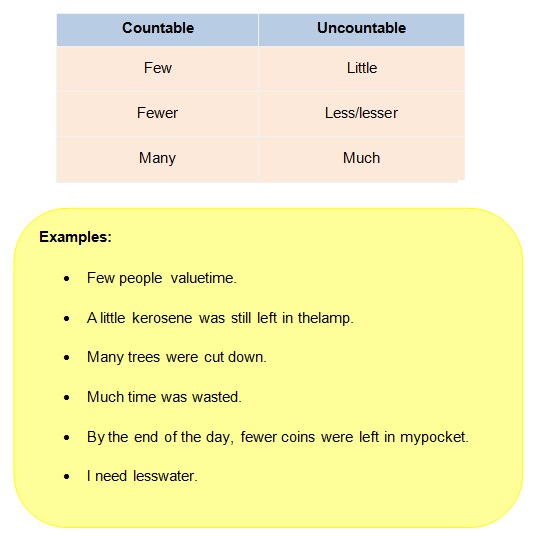
• ‘Many’ and ‘Few’ are adjectives associated with countablenouns.
Examples:
House, bat, key, people, phone
She bought two houses.
How manyhouses did she buy?
The cave was infested by hundreds of bats.
How manybats infested the cave?
What are the features of countable nouns?
• They are concrete andspecific.
• They are independent things which have to be considered separately from others of theirkind.
• Box, toy, cup,jar
• Indefinite articles ‘A’ and ‘An’ can be used only withcountable nouns.
• I need aknife.
• An old man was at thedoor.
• We can use the definite article ‘The’ with countablenouns.
• Try thecake.
• The cat is out of the bag.
• Determiners like ‘That’, ‘This’, ‘These’ and ‘Those’ can be usedwith countablenouns.
• That man isinnocent.
• Those books aremine.
What is an uncountable noun?
• An uncountable noun refers to a thing which cannot be countedbut measured.
• They answer the question ‘Howmuch?’
• The definite article ‘The’ can be used with uncountablenouns.
• We cannot use indefinite articles with uncountablenouns.
• ‘Much’ and ‘less’ are the adjectives associated withuncountable nouns.
Examples:
Milk, water, flour, basalt, air, kerosene, freedom
Pour some milk into the coffee.
How muchmilk should be poured into the coffee?
A lot of water has been wasted.
How muchwater has been wasted?
What are the features of uncountable nouns?
• They are to be considered inmass.
• They cannot be considered as separate, independentthings.
• Powder, syrup,sugar.
• They are usually used with no articles (zeroarticles).
• Can you give mecoffee?
• Laughter is the bestmedicine.
• The definite article ‘The’ can be used with uncountablenouns.
• We live in the goldenage.
• Eat the soup before it getscold.
• We cannot use indefinite articles (‘A’ and ‘An’) withuncountable nouns.
• Things in powdered, liquid or gaseous forms are uncountable nouns.
Note:
You can use an uncountable noun in the countable sense by adding a phrase which indicates quantity.
A loaf ofbread
A lump ofjaggery
Two bags ofrice
Using Adjectives with Countable and Uncountable Nouns
• Adjectives are used to quantify countable and uncountablenouns.
• Adjectives of number and indefinite adjectives are used with countablenouns.
• Ten ducks were flying towards thesouth.
• Samuel invited twenty people to hisparty.
• Some students were senthome.
• The amateur chefs baked manycupcakes.

• Indefinite adjectives are used with uncountablenouns.
• I have a littletime.
• So much water has been wasted by theresidents.
• Vandana has nopatience.
• The moneylender sold it for a lesseramount.
Some indefinite adjectives are specific to countable and uncountable nouns.
Nouns: Gender
Gender
In grammar, gender refers to the sex of the noun. We use grammatical gender to refer to human beings,
animals, plants, ideas and things. We shall learn about identifying the gender of the nouns in this chapter.
What are the Types of Grammatical Gender?
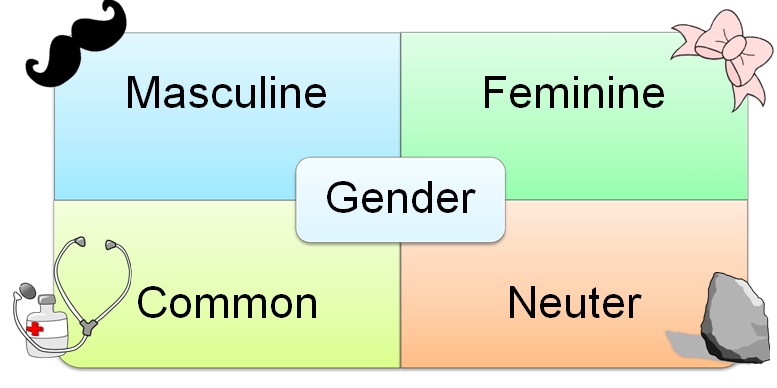
We can divide gender into four categories:
• Masculinegender
• Femininegender
• Commongender
• Neuter gender
Masculine Gender
• Masculine gender is used to refer to nouns which are male (human andanimal).

• It also refers to nouns associated with strength, harshness andaggression.
o The Sun bears down on the Earth with hishot rays.
o Power is a strange friend; hisfriendship is neverpermanent.
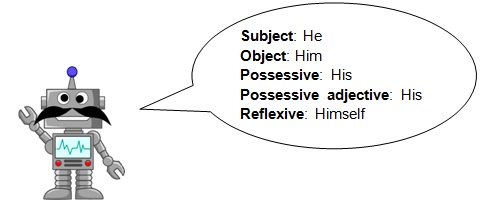
Pronouns for Masculine Gender
• Masculine gender nouns agree with masculinepronouns.
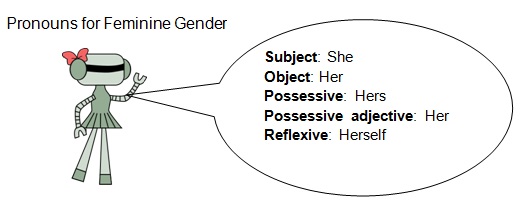
Feminine Gender
• Feminine gender is used to refer to nouns which are female (human andanimal).

• It is also used to refer to nouns which are associated with gentleness, love andsoftness.
o The ship cradled us like we were herchildren.
o Spring blesses us with herbounty.
Common Gender
• Common gender is used to refer to nouns which stand for both male andfemale.
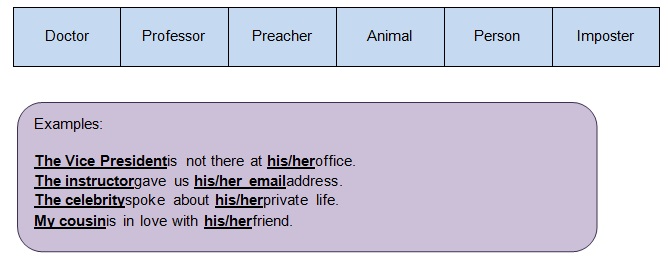
Pronouns for Common Gender
Since these nouns can refer to both genders, masculine and feminine pronouns can be used to refer to them.
Neuter Gender
• Neuter gender is used to refer to things which arenon-living.
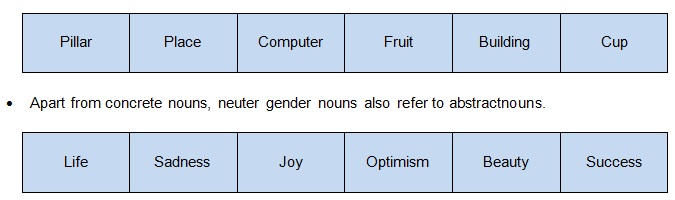

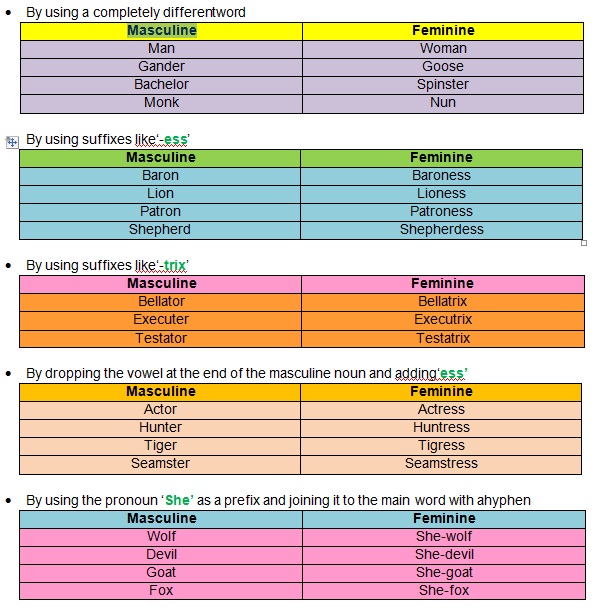
Changing Gender of Nouns
Nouns can be changed from masculine to feminine in the following ways:
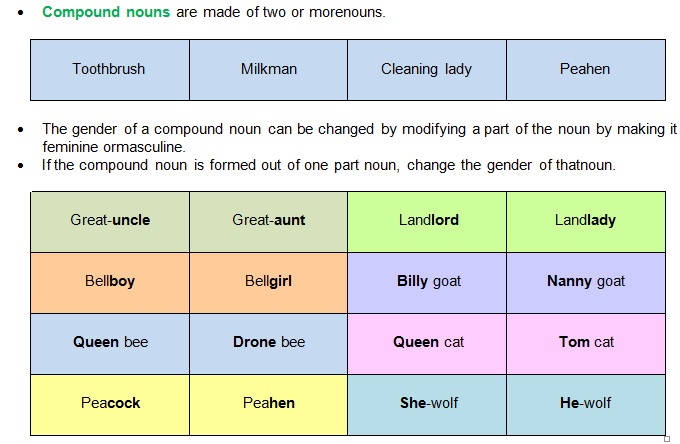
How to Change the Gender of CompoundNouns?
Nouns: Number
What is Number in Grammar?
Previously, we learnt that nouns can be either singular or plural.
What is Singular and Plural?
• When one is speaking about a single thing, person, place or idea, the noun used issingular.
• When one is speaking about more than one thing, person, place or idea, the noun used isplural.
Let us consider the following examples:
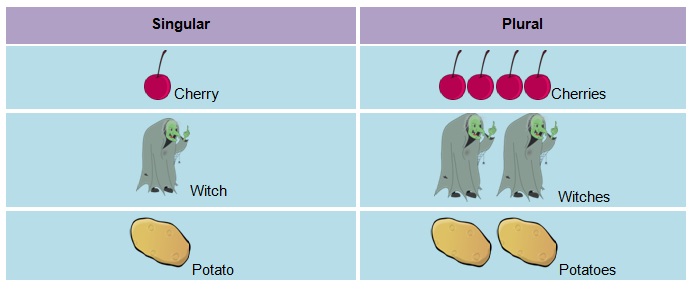
• As is evident from the table above, the noun undergoes a change while turning from singularto plural.
• Most nouns become plural on the addition of ‘–s’ at its end. Example: Stone –Stones
• In English, the rules for changing the number of the nouns are quitediverse.
• In this chapter, we shall learn these rules that govern the number ofnouns.
Changing Singular Nouns into Plural Nouns
Nouns ending with –s, –ss, –sh, –ch, –x

Nouns ending with '–y'
• The plural form of some nouns ending with ‘–y’ is formed by removing ‘y’ from the wordand replacing it with‘–ies’.
• These nouns end with a consonant + ystructure.

Abbreviations and Numbers
• Abbreviations and numbers become plural on the addition of‘s’.
In the 1950s, cinema became popular. They came in sets of threes.
The CVsof the candidates were examined.
The IITsare premier engineering institutes in India.
Compound Nouns
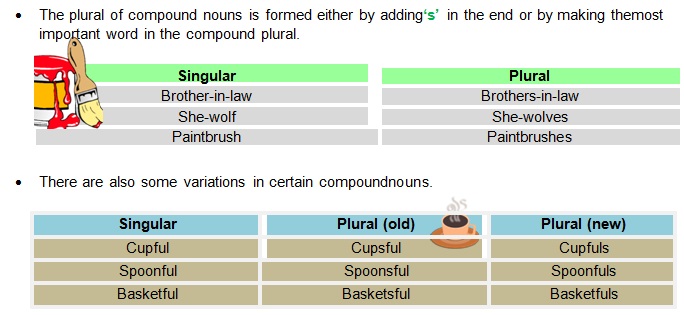
Nouns which are always singular
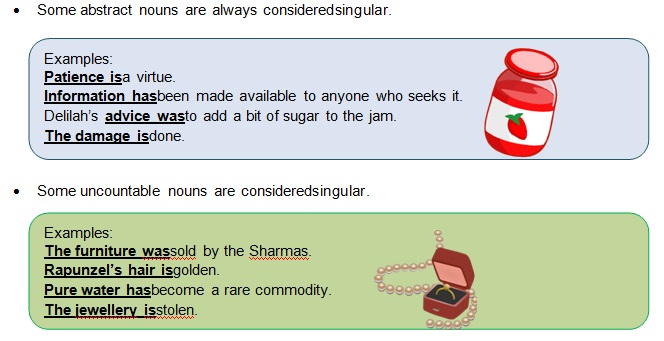
• Singular nouns ending with ‘–s’ are used with singularverbs.
• They may seem plural but are actuallysingular.
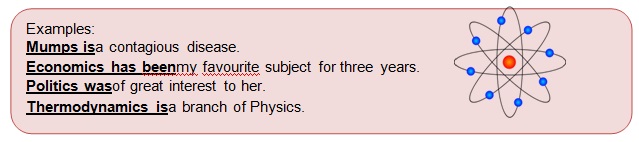
Nouns which are always plural

Nouns that do not change form

Foreign Words
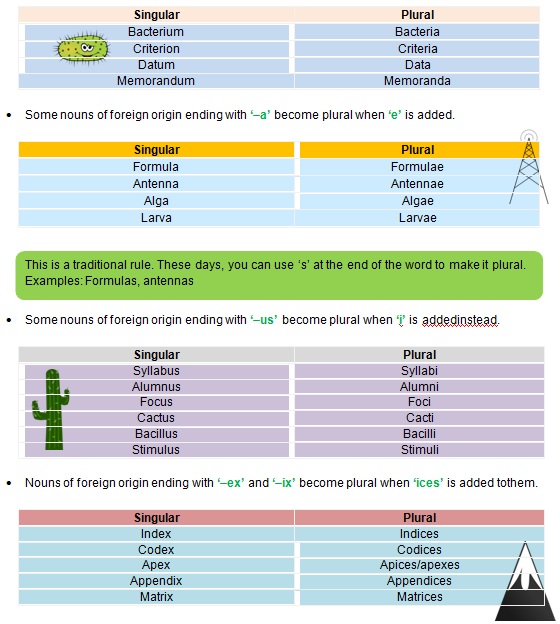
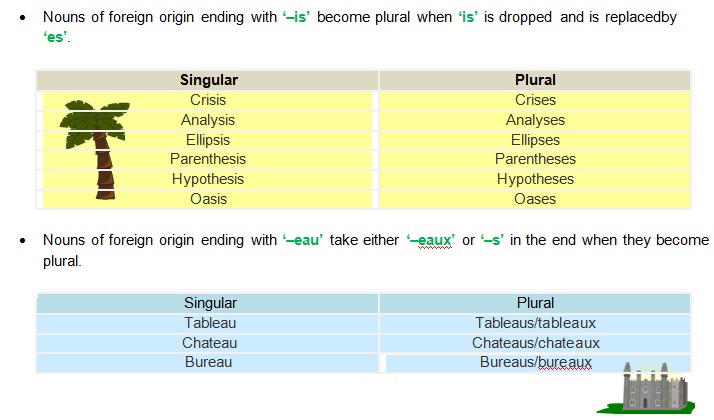
• Some nouns in English are borrowed from other languages like Greek andLatin.
• These nouns do not follow the same rules as other nouns when it comes tonumbers.
• The rules governing these words are distinct to their language oforigin.
• Some singular foreign nouns ending with ‘–um’ or ‘–on’ become plural when the lettersare replaced by‘a’.
Nouns - Possessive Case
What is the Possessive Case?
Let us examine the following phrases:

• In each of the phrases above, the nouns in blue belong to the nouns indicated inred.
• The apostrophe sign (’) is an indicator of the red noun’spossession.
• This is known as possessive case ingrammar.
• It answers the question‘Whose?’
• For example, ‘Whose uncle? Maria’suncle’.
Relationships Expressed through the Possessive Case
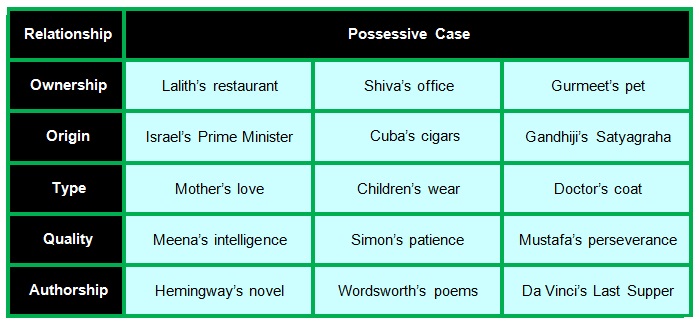
Apart from possession, the possessive case also denotes relationships such as origin, type, quality and
authorship.
Formation of Possessive Cases
Certain rules are applicable while forming possessive cases from nouns.
SingularNouns
• When it comes to singular nouns, we have to affix an apostrophe with an ‘s’ at the end of theword.
The minister’s vehicle
The farmer’s house
The cat’s purr
The clown’s large ears
• An exception to this case will be when the noun itself ends with the letter ‘s’.
In such cases, only an apostrophe ( ’ ) willsuffice.
The linguistics’ theories
Diabetes’ progression
Success’ tale Goodness’ sake
• This exception is also seen in words ending with a hissing sound (sss). Even in such cases,
only an apostrophe can be put at the end of theword.
My conscience’ voice
Justice’ sake
Plural Nouns
• For plural nouns ending in s, the apostrophe is added at the end of the word after the‘s’.
The boys’ shoes
The girls’ hostel
The workers’ association The farmers’ livelihood
• An exception to this case is seen in plural nouns which do not end in‘s’.
• In such cases, ’s is added to the end of theword.
Children’s day
Women’s association
Men’s club
Oxen’s shed
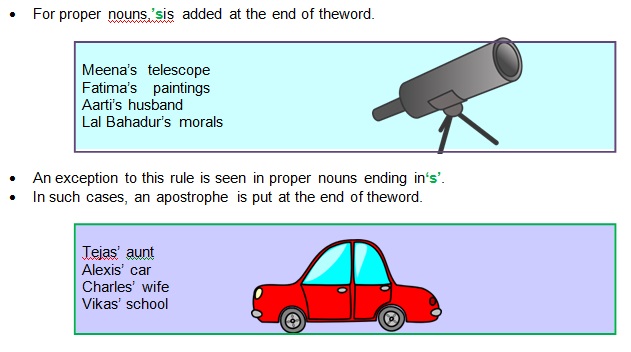
Proper Noun
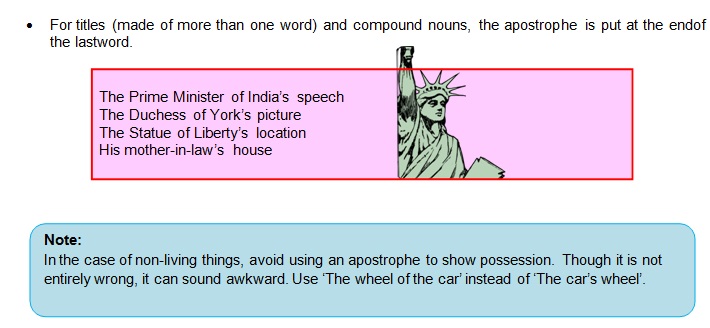
Titles and Compound Nouns
Nouns: Types of Nouns
Revision
Previously, we learnt that nouns are names given to people, places, ideas or things.
Let us now learn about the types of nouns.
Types of Nouns
• The types of nouns which we will learn in this chapterare
• Commonnoun
• Proper noun
• Abstract noun
• Collectivenoun
Common Noun
• Common nouns are names which are given commonly to people, places, things or ideas of the samekind.
• In other words, it is a name shared by all the members of a givencategory.

• In the above examples, the underlined words soldier, wife, house and window are not special names.
• They are common names given to all the members of thecategory.
Proper Noun
• Proper nouns are specific names given to people, places orthings.
• They begin with capital or uppercaseletters.
Mr Royis the Vice President of Acme Technologies.
Parisis one of the great centres of culture.
• In the above examples, the underlined words Roy, Acme Technologies and Paris are specific names.
• Sometimes, proper nouns can be used as commonnouns.
There are two Marysin my class.
An Ayodhyaemerges on the banks of a Sarayu.
• In the first case, the plural form of Mary is used to signify a category of girls who are namedMary.
• In the second case, using indefinite articles with the proper noun Ayodhyaand Sarayusignifies one ofmany.
Abstract Noun
• An abstract noun is a name given to qualities, feelings, ideas, beliefs, areas of study and time periods.
• Abstract nouns represent things that exist as notions and which do not have a physicalform.
Childhoodis an important time in a person’s life.
Philosophyis a complicated subject.
• In the above examples, the underlined words childhood, life, philosophy and subject are
names given to notions which do not have physicalforms.
Collective Noun
• A collective noun is a name given to a group or a collection.
• The things which constitute a collection are taken as a whole.
The little sheep strayed away from the herd.
Miss Glamour was one among the bevy of beautieswho ruled Hollywood in the 60s.
• In the above examples, the underlined words herdand bevyof beauties represent a group ora collection ofthings.