
Important Questions
Multiple Choice questions:
1. What is the successor of 2001?
(A) 2003
(B) 2001
(C) 2002
(D) 2000
2. The largest 5-digit number having three different digits is:
(A) 98978
(B) 99897
(C ) 99987
(D) 98799
3. The difference between 85 and the number obtained by reversing the digits is:
(A) 25
(B) 26
(C) 27
(D) 72
4. The natural numbers along with zero form the collection of:
(A) Whole numbers
(B) Integers
(C) Rational numbers
(D) Real numbers
5. Find value of 297 × 17 + 297 × 3:
(A) 5940
(B) 5980
(C) 5942
(D) 5970
6. The smallest whole number is:
(A) 1
(B) 0
(C) not defined
(D) None of these
7. Find product 12 × 35:
(A) 12600
(B) 34840
(C) 420
(D) 400
8. The difference between the smallest 3 digit number and the largest two digit number is:
(A) 0
(B) 1
(C) 2
(D) None of these
9. What is the quotient of 64 ÷ 1?
(A) 1
(B) 0
(C) 46
(D) 64
10. What are the three consecutive predecessors of 70010?
(A) 70009, 70008, 7007
(B) 70009, 70008, 70010
(C) 70009, 70008, 70007
(D) 70009
11. 3 × 10000 + 7 × 1000 + 9 × 100 + 0 × 10 + 4 is the same as:
(A) 3794
(B) 37940
(C) 37904
(D) 379409
12. Study the pattern 1 × 8 + 1 = 9 12 × 8 + 2 = 98 Next step is-
(A) 123 × 8 + 3 = 987
(B) 1234 × 8 + 4 = 9876
(C) 120 × 8 + 3 = 963
(D) 13 × 8 + 3 = 987
13. Number of whole numbers between 38 and 68 is:
(A) 31
(B) 30
(C) 28
(D) 29
14. The value of 25 × 20 × 5 is:
(A) 2505
(B) 2503
(C) 2500
(D) None of these
15. Value of 0 ÷ 5 is:
(A) 5
(B) 0
(C) 1
(D) None of these
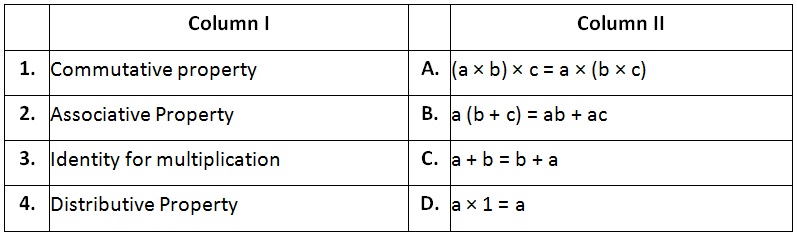
Match The Following:
Fill in the blanks:
1. Division by _____ is not defined.
2. A number remains unchanged when added to ______.
3. A number remains unchanged when multiplied to ______.
4. 13 × 100 × ________ = 1300000
True/ False:
1. All natural numbers are whole numbers.
2. All whole numbers are natural numbers.
3. The predecessor of a two digit number is never a single digit number.
4. 1 is the smallest whole number.
Very Short Questions:
1. How many whole numbers are there between 32 and 53?
2. Are all whole numbers also natural numbers?
3. Complete pattern
1 1 = 1
11 11 = 121
111 111 = _______
1111 1111 = 1234321
4. Write the next three consecutive whole numbers of the following numbers:
I. 39359
II. 8632157
5. A taxi driver filled his car petrol tank with 40 litres of petrol on Monday. The next day,
he filled the tank with 50 litres of petrol. If the petrol costs Rs.44 per litre, how much did
he spend in all on petrol?
6. Find the product by suitable rearrangement:
I. 8 × 391 × 125
II. 2 × 1234 × 50
7. If you’re on a diet and have a breakfast consisting of 150 calories, a lunch consisting of 350 calories,
and a dinner consisting of 1000 calories, then find the sum of the calories consumed that day.
8. Write the smallest whole number.
9. What is the predecessor of whole number 0?
10. Which property do the following statements hold?
(a) 6 + 4 = 4 + 6
(b) 3 + 2 = whole number
11. Add the following in three ways. Indicate the property used.
(a) 25 + 36 + 15
(b) 30 + 18 + 22
12. Using distributive property, solve the following:
(а) 360 × 102
(b) 35 × 98
13. Find the product of the greatest 3-digit number and the smallest 2-digit number.
14. Write the predecessor of the smallest 4-digit number.
15. For n = 5, verify the given statement 10 × n + 1 = n1
Short Questions:
1. Using the properties, find the values of each of the following:
(a) 736 × 102
(b) 8165 × 169 – 8165 × 69
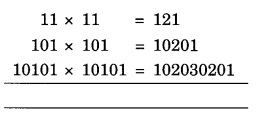
2. Observe the following patterns and extend them by two more terms.
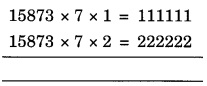
3. Observe the following patterns and extend them by two more terms:
4. Using the properties of whole numbers, find the value of the following in suitable way:
(a) 945 × 4 × 25
(b) 40 × 328 × 25
5. Represent the following on number line:
(a) 3 + 4
(b) 6 – 2
(c) 2 × 4
6. Give one example for each of the following properties for whole numbers.
(a) Closure property
(b) Commutative property
(c) Associative property
(d) Distributive property
7. A dealer purchased 124 LED sets. If the cost of one set is ₹38,540, determine their total cost.
8. Find the product of the greatest 3-digit number and the greatest 2-digit number.
9. Write 10 such numbers which can be shown only as line.
Long Questions:
1. 320 km distance is to be covered partially by bus and partially by train. Bus covers 180 km distance with a
speed of 40 km/h and the rest of the distance is covered by the train at a speed of 70 km/h. Find the time
taken by a passenger to cover the whole distance.
2. Solve the following and establish a pattern:
(a) 84 × 9
(b) 84 × 99
(c) 84 × 999
(d) 84 × 9999
3. Solve the following with suitable and short-cut method:
(a) 86 × 5
(b) 86 × 15
(c) 86 × 25
(d) 86 × 35
(e) 86 × 50
(f) 96 × 125
(g) 96 × 250
(h) 112 × 625
4. Ramesh buys 10 containers of juice from one shop and 18 containers of the same juice from another shop.
If the capacity of each container is same and the cost of each of the container is ₹150, find the total money
spend by Ramesh.
5. A housing complex built by DLF consists of 25 large buildings and 40 small buildings. Each large building has
15 floors with 4 apartments on each floor and each small building has 9 floors with 3 apartments on each floor.
How many apartments are there in all?
6. A school principal places orders for 85 chairs and 25 tables with a dealer. Each chair cost ₹180 and each table
cost ₹140. If the principal has given ₹2500 to the dealer as an advance money, then what amount to be given
to the dealer now?
Assertion Reason Questions:
(1.) Assertion (A) – 17 is the successor of 16
Reason (R) – any natural number, you can add 1 to that number and get the next number i.e. you get its successor.
(a) Both A and R are true and R is the correct explanation of A
(b) Both A and R are true but R is not the correct explanation of A
(c) A is true but R is false
(d) A is false but R is true
(2.) Assertion (A) –99 is the predecessor of 100
Reason (R) – any natural number, you can substract 1 to that number and get the next number i.e. you get its predecessor.
(a) Both A and R are true and R is the correct explanation of A
(b) Both A and R are true but R is not the correct explanation of A
(c) A is true but R is false
(d) A is false but R is true